
– Discussions with people in the
Japanese media localization industry –
Carrick Lomas
Can you tell us about yourself?
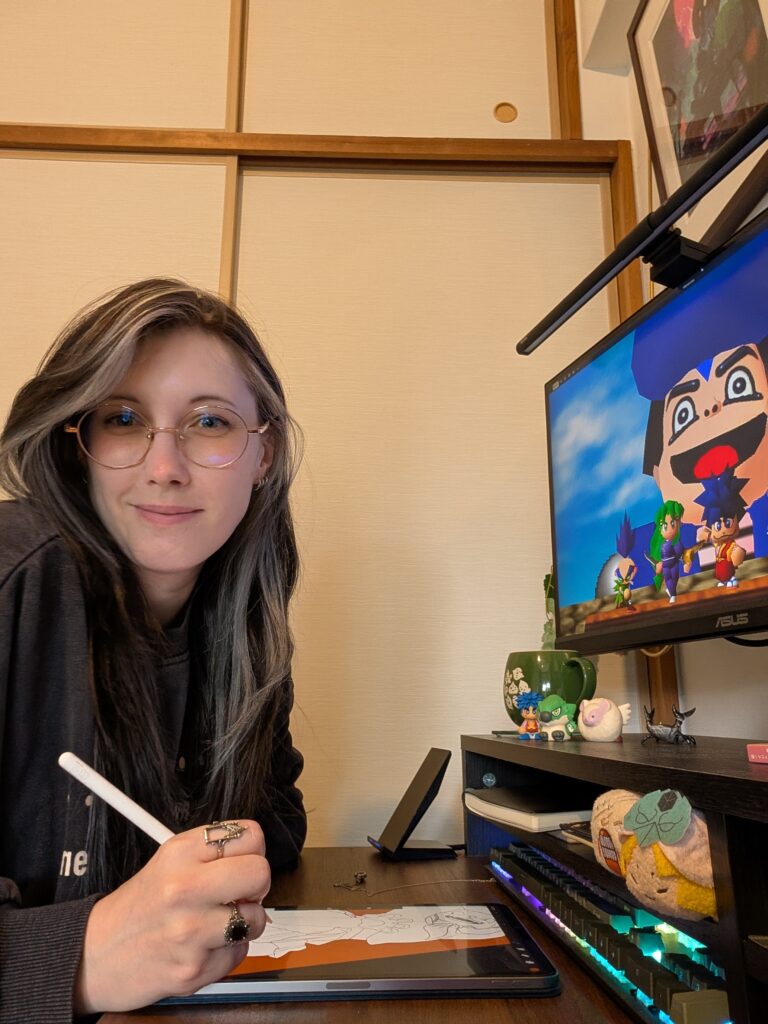
I can indeed! My name’s Carrick, and I’ve been working (with varying degrees of intensity) in localisation since 2015. I’m from a small village in the south of England and found a lot of escape in video games, so I grew up with big Hercules ‘I Can Go the Distance’ energy looking to carve a corner for myself in the industry.
I have since been living in Japan for 9 years and where I’ve juggled jobs in game localisation and indie publishing support—it’s a pretty cosy corner if I do say so myself.
How did you get into localization?
(Carrick’s life story in brief)
It all began when I flunked secondary school.
I was totally uninspired—my hometown didn’t have the facilities to help me with my obscure demands for an artsy-fartsy video game career and the internet was still too early in its infancy to yield useful direction.
I floated around doing art courses at college, dropped out thrice, and worked for a video game store for a couple years subsisting on the dreams of making it to Japan, until a friend pointed out that I should probably try learning the language first. Right, of course! Let’s do that! So, I found a diploma that would help me get the points I needed to enroll at a university.
With that hurdle leapt, I later discovered the ‘injustices’ of localisation in games and anime while studying Japanese, and my interest in the localisation process grew.
My goal shifted from this amorphous, blobbular ‘live in Japan, work in video games’ to the ever so slightly more direct ‘live in Japan, translate video games’. So! Once I’d gotten my Bachelors degree, I went ahead and joined a Masters in translation.
Studying the differences in disciplines and translation theory in particular was deeply enlightening and completely flipped how I looked at localisation.
(Tangent: I do think it made me a little naïve on how translation works as a business, at least insofar as how the video game/anime/localization industry operates, but that’s a topic to be had over greasy izakaya drinks…or another one of these interviews).
Anyway, from there, I moved to Japan and with the help of many wonderful people, I networked my ass off and was slowly able to achieve my ‘live in Japan, translate video games’ goal.
What have been some of the biggest challenges for you on your path to becoming a translator?
Hands down, my own ego has been my biggest obstacle.
I’ve thrown myself at both ends of the spectrum—from indignantly proofreading others’ translations, to being extremely humbled by somebody proofreading my translation. It’s hard not to be in a field that’s so creatively driven!
And, excuse me as I briefly place a toe on my soapbox, but the industry simply isn’t equipped to foster good writing/translation in a healthy way. I know multiple, amazing people who are working hard in their own time to change that, though (coughJenncough).
Finding my footing was probably the hardest part of getting into video game localization, specifically. I never liked the idea of an inhouse translation job, so I balanced (with varying degrees of success) freelancing part-time with working a main 9-6 job, which made time and energy a big factor in my quality and how much I was learning.
I was lucky a couple years in, when an industry colleague offered me a spot in a roundtable team where we would translate and then proofread each other’s work, making necessary changes according to that feedback and then finally submitting for review.
I’ve never seen anyone else pull this off, and while it was crazy stressful and took a lot of time, it was a huge boon for me and I developed a deeper understanding of my limitations and how far I could stretch creatively.
– Your Loc Work –
What’s your translation workflow like?
I LOVE anything to do with world building because it’s not just about the content, it’s about how it’s conveyed.
I love how language can be used to set tone—lingering sentences for something romantic and unknown, biblical or archaic sentence structure for something historic and broody, snappy sentences oozing with active voice for attractive marketing copy…
Pushing my writing style to match the audience the text is intended for is probably the most fun for me. I love the idea of being a chameleon behind my words.
What have you been most proud of?
Harvestella, even though neither I nor the other translator were credited for it (booo~)!
And it’s not because I think my work on it was of a legendary standard, far from it! But I was chatting with my little sister one day, and she was complaining at me about how short the Link’s Awakening remake was (she never played it on the Gameboy, forgive her). Anyway, she said, “D’you know what game I have played recently that I really liked and you should play, too? Harvestella.”
That feeling was indescribable. It was like everything I’d been working for finally made sense… Which absolutely pales in comparison to her, who is now a Sister Nurse in the NHS. But this story’s about me, so whatever.
My sister and I don’t really talk about boring work stuff, and of course, my name wasn’t in the game (not that she would’ve watched the credits anyway), but I took enormous pleasure in regaling her on how I’d worked on it and discussing which stories and characters we liked.
Having my name in the credits began to matter a lot less to me after that, personally, but you should absolutely credit your translators! Don’t be a dick.
Is there something you worked hard on that you think no one noticed?
I really liked some of the work I did for The Good Life by Swery and White Owls Inc. For those who don’t know it, it’s a story of a photographer/journalist from New York who’s found herself in a sleepy village in the north of England (Cumbria, specifically) just in time to see it turned on its head following the murder of beloved local.
I was brought on to help with the editing of the locals and injecting their personalities with British flavour, which was a lot of fun. Despite being raised south of London, my parents were both from up norf so I was able to supplement what I already knew with more Cumbrian content (thank you, Postman Pat).
It was fun being encouraged to really roll with the stereotype.
If you could do anything, what would you love to do or try out?
Horror. Give me all your dark, spooky, and gloomy games please. I’ve taken a keen interest in reading horror especially, and would love the chance to work on something in that realm.
Like any other genre, what people find scary differs by culture, and localising that to maintain the same air of mystery and dread ignorant of those boundaries would be a fun challenge.
– Study and Inspiration –
What do you do (besides translation/editing for work) to hone your skills?
Read, travel, talk, listen! You can’t draw from a well that’s run dry, so I try to keep up with reading, traveling, and resting to add a few drops to that well of inspiration where I can.
If you could share one piece of advice for aspiring media translators/editors, what would it be?
Acknowledge your ego. Easier said than done in a career that’s so fueled by creativity, and something I fumble with still, but see everything as an opportunity to learn and contribute to a better project.
Being assigned as a proofreader can suck when your heart dreams of translation, but it’s a chance to see how others tackle phrases or for you to elevate text (if you’re on the project as an editor, especially).
There are very few people I’ve worked with who I feel wouldn’t benefit from proofreading/editing the work of others from time to time. As I mentioned earlier, the localisation industry isn’t really structured to foster better localisers and writers, so I find proofreading is a poorly paid means of self-learning.
– The Industry in General –
What do you think people don’t know about localization that you wish would?
It’s a hot button topic, but literal translation is a disservice to the original text. What might read smoothly in the original language will read like a car on square wheels in the target language. I don’t care what people on social media say about ‘unnecessarily punching up text’. Fuck that. Punch it up. Have fun with it and create something the audience can have fun with too.
At one point during my masters, we discussed the question: should the translator be invisible? Should the translator be identifiable in their translation?
In my mind, it’s clearly impossible not to be visible as a translator—particularly in the realm of creative writing where our lived experiences influence our interpretations!
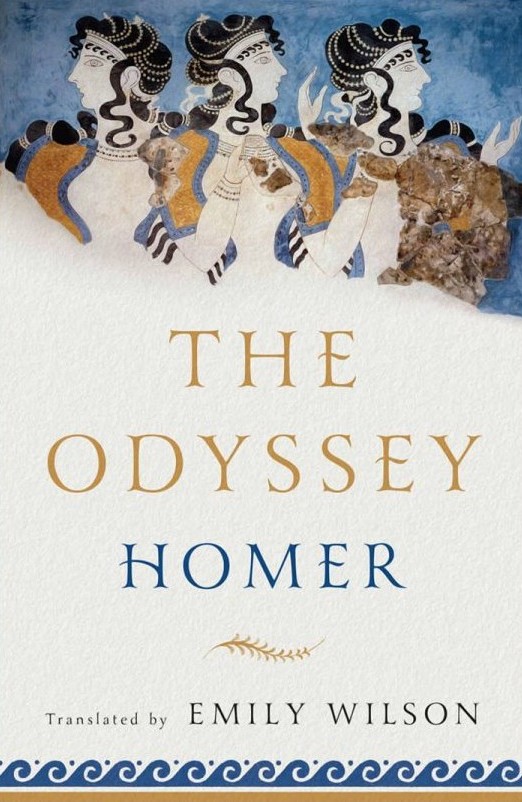
Homer’s The Odyssey, as a quick example, has had some 60 translations into English alone, each with a different perspective influenced by age, generation, race, and gender (the first female translation was written in 2017 by Emily Wilson, who really shone a light on certain gendered attitudes of translations past. Read about it if you haven’t. I promise it’s interesting!).
So how can we be invisible when these factors influence how we wright? How can we decide which one of those 60 interpretations of Homer’s Odyssey is the right one when our own attitudes and expectations differ so wildly?
Bearing that in mind, my attitude was the polar opposite when I first dabbled in translation and localisation, but studying translation theory and living the localisation process really turned my understanding on its head.
There can be no one true translation of any creative text because a translator’s biases will shine through regardless, but we can do our best to be as faithful as possible—be it to the language, to the tone, or wherever we feel that importance lies.
How do you think the industry has changed since you started?
Machine translation has definitely been encouraged a lot more aggressively by localisation agencies as a means of cutting cost.
Just recently I’ve received emails from clients asking me to reconsider my rates in the case of Machine Translation Post Editing (MTPE), but I think that’s implementing these tools in entirely the wrong way—using them to cut corners instead of increase efficiency.
This doesn’t happen everywhere, mind, and there are still many companies and clients that prioritise human translation, but it’s frustrating to see it become more common with the rising costs of development/living/eating/sleeping/breathing.
For those companies that no longer prioritise human translators and continue to drop rates however, and this could be overly optimistic of me, I believe there has to be a breaking point. Either their translation quality drops to the point of ridicule, and/or they struggle to find artists and talented writers willing to work with them for the abysmal rates they pay.
It’s not going to happen right away, but I think audiences will start to take notice as attitudes towards the implementation of AI in creative sectors continue to sour.
How do you think the industry will change in the future?
I think the consciousness that localisation exists has grown a lot since I started professionally as places push to include translator’s names in credits and on book covers.
This has resulted in a lot of heated discourse (some more productive than others), but for something that was considered an afterthought within game development…and still is, in some instances…seeing translators proud of their work and encouraging others to develop in the field never gets boring!
It’s sure to lead to more industry professionals working together with developers, agencies, and fledgling translators in a way that will improve localisation quality as a whole.
I’m not particularly active on social media, but you can typically find me by my online handle Japantaloons on Bluesky, Instagram, or Discord.
There’s also my LinkedIn where I parade as a professional from time to time: LinkedIn